









Oba Ladoja: Tested by Storms, Crowned by Destiny By Taiwo Adekola
Ori to ba maa d’ade inu agogo ide ni ti nwa, orun ti o lo ejigbara ileke inu agogo ide ni ti wa, ibadi ti o lo mosaaji aso oba ti n tana yanran yanran, inu agogo naa ni ti nwa.
In the journey of men, destiny is the compass that never misleads. It is patient, unyielding, and precise. Although it may tarry, it may bend with the storms, in the end, it directs all things towards fulfilment at the appointed hour. For Kabiyesi, Oba Rashidi Adewolu Ladoja, today marks that hour — the day destiny finds its voice as he ascends the throne of warriors as the 44th Olubadan of Ibadanland.
This is no ordinary coronation, it is the climax of a story that reads like the script of fate itself. It began eighty-one years ago in Gambari, where the young Adewolu first learned the values of hard work, courage, and dignity. That boy grew into a man of commerce, building a successful career in business at home and abroad. Adewolu’s childhood bore the markings of greatness: education refined him, business elevated him, and politics tested him. He became not only wealthy but wise, seasoned by the lessons of leadership in the boardroom, and in the council chambers at Agodi. Yet beyond each phase destiny was guiding him toward the beaded crown.
I began to follow him closely — as a primary school pupil — after the 2003 elections, when he emerged as Governor of Oyo State under the platform of the People’s Democratic Party (PDP). There was something about Ladoja’s stride, his convictions, and his devotion to Oyo State that drew me in. His administration pursued reforms in education, agriculture, and infrastructure, but soon the storms gathered. Political battles raged, and in January 2006 he was impeached in a move that shocked the state and rattled the nation. To many, that was the end of the story. But destiny does not surrender to the plots of men.
He fought. He went to the courts, armed not only with the law but with an unshakable belief in justice. And in December 2006, he returned to office after the apex court nullified his impeachment — a rare and historic reversal in Nigerian politics. That moment etched his name in the annals of resilience. He became a symbol of hope for the hopeless, a lesson that power can be wrestled back by courage and conviction.
It was in those turbulent days that I developed not just admiration but a deep emotional connection to his cause. He became to me more than a governor; he became a symbol of resilience, proof that a man can be bruised but not broken. His return to Agodi was more than a personal victory; it was justice bowing to destiny.
When his gubernatorial tenure ended in 2007, many thought the curtain had fallen on his relevance. But Rashidi Ladoja was not a man to be written off. With the birth of the Accord Party, he rewrote the political script of Oyo State. Against the dominance of the PDP and the defunct ACN, Accord became a household name — a genuine third force that electrified the political landscape. At its peak in the 2011 elections, Accord won a significant share of the Oyo electorate, with seven State House of Assembly seats and four National Assembly seats. Even though the main man lost his bid to return to Agodi, It was clear that Rashidi Adewolu Ladoja was not just another politician; he was a movement — a man whose name could never be ignored in the politics of the Southwest.
Yet perhaps his most defining test after politics came not at the polls but in the palace. During the late Governor Abiola Ajimobi’s controversial attempt to elevate Ibadan high chiefs and baales to obaship status, Ladoja stood alone in defiance. While others accepted the new crowns, he refused. He insisted that Ibadan’s ancient succession system, tested by centuries, was sacrosanct and could not be diluted by executive fiat. In that lonely fight, he became “the last man standing” beside the then Olubadan, Oba Saliu Adetunji. History has vindicated that stance, for without it, his ascension today would have been muddied. By protecting tradition, he protected his own destiny.
Now, in the twilight of his years, Adewolu takes his seat where destiny always intended: at the head of Ibadanland. His journey has been long, marked by victories and betrayals, setbacks and comebacks, but each chapter has led to this crowning moment. The boy from Gambari who became a businessman, the businessman who became a governor, the governor who became a symbol of resistance, has now become king. His life, in all its battles and triumphs, mirrors Ibadan itself: resilient, unbroken, and destined to rise.
But this coronation is not just about fulfilment; it is also about the future. Ibadan is a city of enormous cultural, political, and economic value — a city that has given Nigeria warriors, thinkers, entrepreneurs, and leaders. It is a city that has always demanded a leader equal to its spirit. With Adewolu on the throne, Ibadan gains a monarch forged in the crucible of politics and seasoned by the lessons of both triumph and defeat. His reign holds the promise of balance: the wisdom of tradition joined with the experience of modern governance.
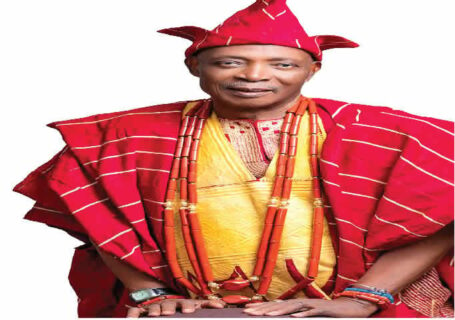
The beaded crown resting upon his head symbolizes not only honour but also responsibility. Ibadan looks to him for unity in diversity, for justice in leadership, and for the preservation of its proud heritage. In him, the people see a king who has known battle, who has endured storms, who has stood alone for truth, and who now wears the crown as destiny’s final gift.
Oba Ladoja’s life is proof of an eternal truth: men may scheme, power may falter, storms may rage, but destiny will always be fulfilled. And today, in Ibadanland, destiny has found its fulfilment in the person of Oba Rashidi Adewolu Ladoja, Arusa I, the 44th Olubadan.
Kabiyesi,
Ki ade pe lori,
Ki bata pe lese,
Ki esin oba o je’ko pe,
Ki ase o wa pe lenu kanrin kese.
Ase.