











Bloody revolution erupts over Facebook and Instagram ban as parliament is burned down and ex-first lady killed in Nepal
NEPAL’S former first lady has been killed after a social media ban sparked unprecedented violence leaving at least 19 people dead.
Gen Z protesters set fire to Nepal’s parliament and four-time prime minister KP Sharma Oli’s house – forcing his resignation.
Rajyalaxmi Chitrakar, the wife of former Prime Minister Jhalanath Khanal, reportedly died after she became trapped inside the couple’s home that was set ablaze by protesters.
Her death comes as at least 500 have been left injured in the violent riots, which erupted earlier this week.
Nepal’s capital, Kathmandu, was pictured engulfed in thick black smoke as military helicopters tried to quell the riots.
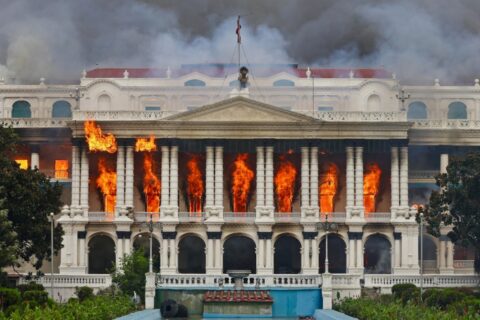
Terrifying pictures show flames tearing through the Singha Durbar palace – which houses government offices- as crowds gathered outside.
While scorched vehicles appear strewn across the road next to singed debris.
The protesters, the majority of whom are young men, tore through the city, brandishing weapons and torching the supreme court.
The attorney general’s office, the prime minister’s house, parliament, and other homes belonging to politicians were also set alight.
Rajendra Bajgain, a member of parliament, told The Telegraph: “Kathmandu is burning. Smoke is emanating across the capital’s seat of power as protesters have set fire to many important offices”.
Amid the chaos, four-time prime minister Mr Oli stepped down to allow “further efforts toward a constitutional political solution”.
Citing the country’s “extraordinary situation” he said: “I hereby resign from the office of Prime Minister, effective immediately, under Article 77(1)a of the Constitution.”
His resignation comes as protesters defied an indefinite curfew that was later lifted after protesters violently clashed with police.
Yesterday, tear gas and water cannons were deployed in a bid to protect political residences.
But riot police were forced to retreat to safety after crowds surged and surrounded the parliament building.
The riots erupted after government blocked more than a dozen social media platforms, including Facebook, X and YouTube for not complying with new legislation.
THE riots erupted after government blocked more than a dozen social media platforms, including Facebook, X and YouTube for not complying with new legislation.
Officials argued the regulation is needed to prevent the spread of fake news and internet fraud.
Critics – many of whom are students – have blasted the measure as censorship.
According to the Kathmandu Post, the riots aren’t “just about social media” but are the result of growing distrust in a “corrupt” regime.
The paper wrote: “This isn’t just about social media – it’s about trust, corruption, and a generation that refuses to stay silent.
“Gen Z grew up with smartphones, global trends, and promises of a federal, prosperous Nepal.
“For them, digital freedom is personal freedom. Cutting off access feels like silencing an entire generation.”
Officials argued the regulation is needed to prevent the spread of fake news and internet fraud.
They insist firms were given repeated notice to officially register, but failed to act.