















Oyo Gov Advocates for Cheaper, More Accessible Organ Transplants
Oyo State Governor, Seyi Makinde, has emphasized the need for proper awareness and increased medical facilities to address organ transplantation challenges in Nigeria.
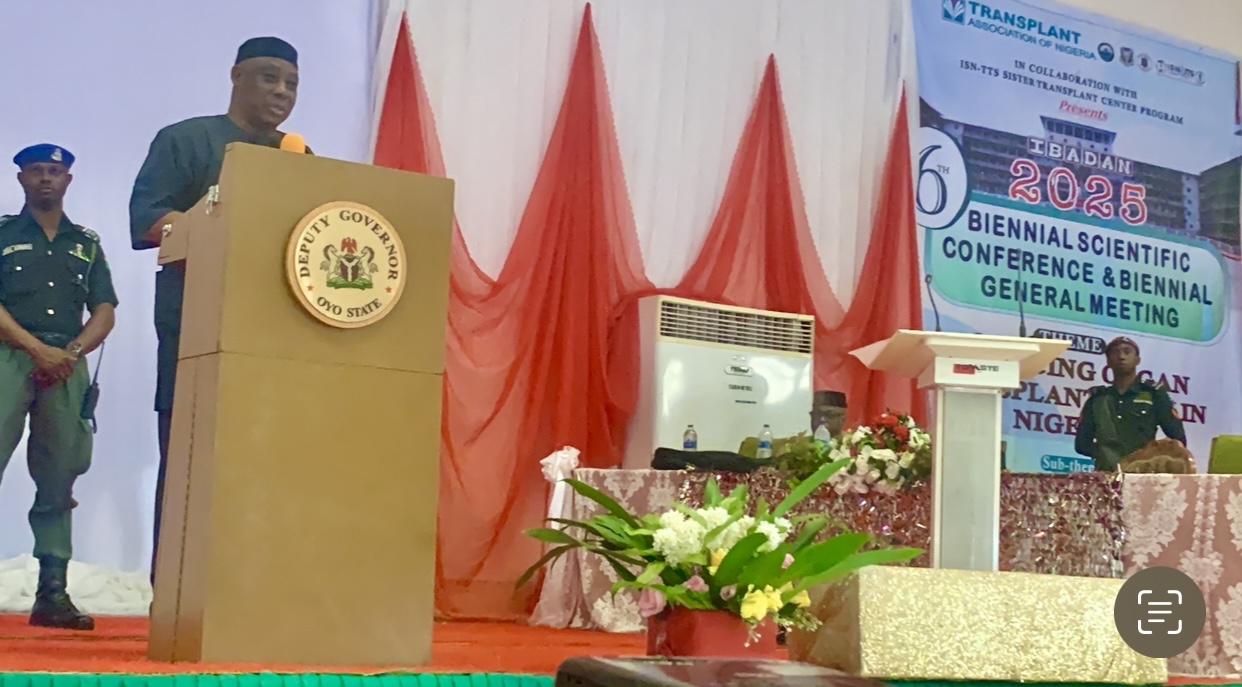
Speaking on Monday at the 6th Biennial Scientific Conference and Biennial General Meeting with the theme “Financing Organ Transplantation in Nigeria”, hosted by Transplant Association in collaboration with ISN-TTS Sister Transplant Center Program and a sub theme Paediatric Organ Transplantation In Nigeria held at Emeritus Professor Theophilus Ogunlesi Mulyipurpose Hall, University College Hospital, Ibadan, Nigeria, the Governor advocated for more medical outfits to make organ transplantation more affordable and accessible.
Governor Makinde, who was represented by his Deputy, Barr. Abdul-Raheem Adebayo Lawal, noted that organ transplantation activities are often prohibitively expensive in Nigeria, unlike in Europe, America, India, among others.
He highlighted common factors endangering lives, such as air and environmental pollution, smoking, and alcohol consumption, which can lead to organ damage.
The Governor stressed the importance of striking a balance between organ transplantation and healthcare services in Nigeria.
While urging the Transplant Association to extend awareness efforts beyond their members to the general public, Governor Makinde emphasized the need to curb the consumption of harmful substances, such as those found in places where they sell “Paraga”, and other substances detrimental to kidney health.
The Governor reiterated the need for more medical facilities to reduce the cost of organ transplantation, noting that 60% of our populations live below the poverty line, making it essential to increase access to affordable medical care.
“On behalf of His Excellency, the Governor of Oyo state, Seyi Makinde, I appeal for more medical facilities to address the challenges facing organ transplantation in Nigeria, ensuring this life-saving procedure is accessible to all,” he said.
Earlier in his remarks, the president of Transplant Association, Prof. Jacob O. Awobusuyi, said the association is assembling in the lively city of Ibadan, the Pace Setter and the largest Indigenous City in Africa, for what promises to be a thought-provoking and forward-looking engagement on the future of organ transplantation in Nigeria.
According to the president, this year’s theme, “Financing Organ Transplantation in Nigeria,” could not have been more timely, nor more urgent stressing that across the country, the need for organ transplantation – particularly kidney, liver, and heart – has grown exponentially.
He said: “Yet for many of our patients, the hope of a lifesaving transplant remains dimmed, not because of a lack of expertise or facilities, but because of the heavy financial burden that transplantation imposes. Indeed, we have made commendable strides in building capacity and advancing the science and practice of transplantation in Nigeria. From a time when organ transplantation was merely aspirational, today we can boast of centres performing regular kidney transplants, an emerging interest in liver transplantation, and encouraging collaborations within and beyond our borders.
“This progress has been made possible by the dedication of our transplant surgeons, nephrologists, hepatologists, anaesthetists, nurses, coordinators, and indeed everyone who contributes to the transplant ecosystem. However, despite these successes, we are reminded daily of the painful reality: for many Nigerians, the cost of a transplant is simply out of reach. Thousands still languish on dialysis with little hope of moving forward. Families are forced to sell properties, deplete life savings, or worse still, abandon treatment altogether because of the insurmountable cost.
“This year’s conference, therefore, challenges us to confront this critical issue head-on. How can we make organ transplantation financially accessible and sustainable for Nigerians, regardless of their socioeconomic status? What financing models – public, private, insurance-based, philanthropic- can we explore and adapt to our context? How do we engage policymakers, civil society, and development partners to make transplantation a priority in our health agenda? These are not easy questions, but they are necessary if we are to move beyond the status quo and ensure equity in access to transplantation services.
“Our sub-theme this year, “Paediatric Organ Transplantation in Nigeria,” also underscores an Often neglected but equally pressing concern. Children, our most vulnerable population, face unique challenges when it comes to transplantation. From donor availability to size compatibility, immunological considerations, and lifelong follow-up, paediatric transplants demand a different And of sensitivity, planning, and support. This conference offers us an opportunity to shine the spotlight on these little warriors and chart a course for improving their outcomes.
“Over the next few days, we will hear from thought leaders, policy experts, clinicians, and Over thners Who wil share insights, experiences and bundlnti, ind Strengthenerate on strategie researchacy, sustainable financing models, capacity burking a in collaboratining our transpal. foraramnes. We will also have opportunities for networking and collaborations that wilenir. our individual and collective efforts.
“To our invited international guests and partners, we extend a speciat welcome. Your willingnes to In ou vour expertise and collaborate with us reaffirms the global nature of our cause and reminds us that in medicine, there are no borders – only shared humanity.
To the members of our Local Organizing Committee and al who have worked tirelessly to make this conference possible, I say thank you for your dedication and hard work. Planning an events this scale is no small feat, and you have done a remarkable job.
“As we reflect on the work that lies ahead, let us remember why we do what we do. Every successful transplant is more than just a medical procedure; it is the restoration of hope, the gift of time, and the reaffirmation of life itself. Our mission goes beyond the operating theatre. It is about making sure that every Nigerian who needs a transplant has a fighting chance to receive one, irrespective of their ability to pay.
“This is a defining moment for our profession, and I urge us all to seize it with courage and conviction. Let this conference not just be a place where we discuss ideas but where we take decisive steps toward solutions that will make organ transplantation in Nigeria more equitable, more sustainable, and more impactful. Together, we can build a future where no Nigerian dies needlessly because they cannot afford the gift of a second chance at life. Together, we can make transplantation not a privilege for the few but a right for all who need it.
“Once again, I welcome you all to TANCONF 2025. I encourage you to participate actively, to engage with new ideas, and to build new connections that will strengthen our shared mission.”
Also speaking, the chairman of the occasion, Prof. Olayiwola B. Shittu, in his opening remarks, said that transplantation and kidney failure did not become popular in the public institutions for a long since it was done in the private sector. He maintained that the cost is so enormous in the private sector, stressing that such practice in the public sector has remained challenging.
On his part, the chief medical director, university college hospital, Professor Jesse Abiodun Otegbayo, said Organ transplantation represents one of the most advanced and life-saving interventions in modern medicine. Yet, for many Nigerians, it remains far beyond reach not because of lack of expertise, but primarily because of the enormous financial burden.
According to him, the reality is stark: while our medical professionals have proven skill and resilience, patients and their families are often left in despair, unable to afford the procedures that could save lives.
He said: “This conference therefore provides a timely platform for us to interrogate practical solutions. Financing organ transplantation in Nigeria cannot rest solely on the shoulders of patients. We must think innovatively about sustainable models: government-led health insurance schemes, public-private partnerships, philanthropic contributions, corporate social responsibility initiatives, and international collaborations. Each of these avenues has the potential to reduce the inequities that currently deny many patients access to transplantation.
“Distinguished colleagues and friends, when we finance transplantation sleguately, we are not merely funding procedures, we are restoring families, preserving productivity, giving our fellow citizens a renewed lease on life and a Renewed Hope in tandem with the Agenda of President Bola Ahmed Tinubu, GCFR.
“On behalf of the Honourable Coordinating Minister of Health and Social Welfare, Prof. Mohammed Ali Pate, the Management, Staff, Students and our Patients, I congratulate the leadership of the Transplant Association of Nigeria for sustaining this biennial tradition and for courageously placing financing at the Centre of our discussions this year. I wish you fruitful deliberations and outcomes that will resonate far beyond this hall and bing real change to patients who are waiting, often desperately, for a chance to live.”