






Oil Prices Dip as US-Iran Truce Reopens Strait of Hormuz
US and Iranian presidents have signed an initial peace deal aimed at ending the war, with provisions to take effect immediately.
The agreement includes reopening the Strait of Hormuz, a $300bn (£224bn) plan for Iran’s “reconstruction”, and the US terminating “all types of sanctions” on Iran.
However, Iran’s nuclear programme — the main reason the US cited for the conflict — is still to be negotiated over an extendable 60-day period.
US President Donald Trump signed the deal in France during the G7 summit and defended it, saying it would prevent an “economic catastrophe”. He warned, though, that the US would “bomb the hell” out of Iran if no final deal emerged.
Iranian President Masoud Pezeshkian also signed the document on Wednesday, Tehran confirmed.
Iran’s parliamentary speaker and lead negotiator, Mohammad Bagher Ghalibaf, told state media his distrust of the US remained and that Iran’s “finger is on the trigger”.
“If the enemy does not understand the language of logic, we will respond in the language of power,” he said.
The US and Israel launched attacks on Iran on 28 February, reportedly assassinating Supreme Leader Ayatollah Ali Khamenei and top military officials on day one.
Since then, the conflict has escalated, driving up energy prices and renewing inflationary pressures after Iran imposed a de facto closure of the Strait of Hormuz. About 20% of the world’s oil and liquefied natural gas (LNG) usually passes through the waterway.
Speaking at the lakeside resort of Évian-les-Bains, where the G7 summit was held, Trump said the plan would avert “worldwide depression”.
“I didn’t want to see economic catastrophe,” Trump told reporters. “If this kept going, that could have happened. Every time we talked about the possibility of peace, the stock market shot up like a rocket ship. Every time we said something negative, like ‘we’re not going to be able to settle’, it would go down big.”
Oil prices dipped after the agreement was announced. In early Asia trading on Thursday, Brent crude was about 1% lower at $78.79 (£59.21) a barrel, but it remained roughly $8 higher than before the conflict began.
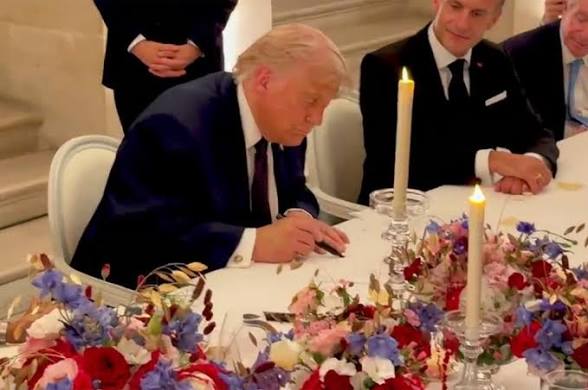
Trump signed a hard copy of the initial deal — a memorandum of understanding — during a state dinner hosted by French President Emmanuel Macron at the Palace of Versailles.
The text states that the US and Iran will “commit to negotiating and achieving the final deal in a maximum of 60 days, extendable with mutual consent”.
The agreement says “Iran reaffirms that it shall not procure or develop nuclear weapons”, which has been Trump’s primary condition since the war began.
The memo also says Iran’s enriched uranium will be “down-blended” — meaning diluted — on site, under the supervision of the IAEA, the UN nuclear watchdog. Originally, the US had demanded the material be removed from the country entirely.
On the Strait of Hormuz, the agreement waives charges for ships passing through the waterway for 60 days. The memo leaves open the possibility of future charges. There were none before the conflict.
Ghalibaf said in a state TV interview that the Strait “will not return to pre-war conditions” and suggested Iran would charge ships crossing after the 60-day period lapses.
While Trump previously vowed to obliterate Iran’s ballistic missiles, he said at the G7 it would be “OK” for Tehran to have them “if other countries have them”.
The agreement’s first point declares the “immediate and permanent termination of military operations on all fronts, including in Lebanon”.
Israel, however, said it had no plans to withdraw troops from Lebanon and launched attacks on Hezbollah on Wednesday.
Trump expressed concern that Israeli operations against Hezbollah could derail the Iran deal and admonished Prime Minister Benjamin Netanyahu at the G7.
“Netanyahu is a good man, but he could use a softer touch,” Trump said. “You don’t have to knock down a building every time someone from Hezbollah walks into it.”
After dinner at Versailles, Trump began his return to Washington, where the peace plan has unsettled lawmakers on both sides of the aisle, including members of his own party.