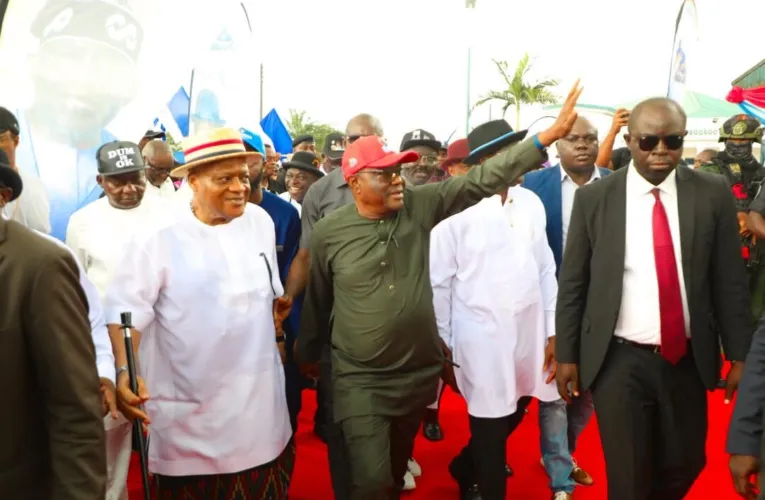
The Minister of the Federal Capital Territory (FCT), Nyesom Wike, has declared that Nigeria must not be handed over to politicians he described as gamblers, insisting that President Bola Tinubu’s economic reforms are beginning to yield positive results and should be allowed to consolidate.
Wike reiterated that the removal of fuel subsidy by the Tinubu administration had increased financial allocations to state and local governments, creating opportunities for them to execute development projects and improve the living conditions of their people.
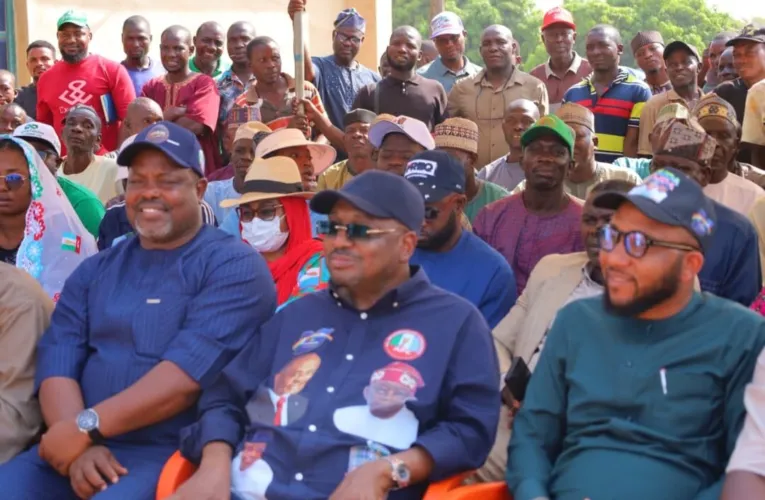
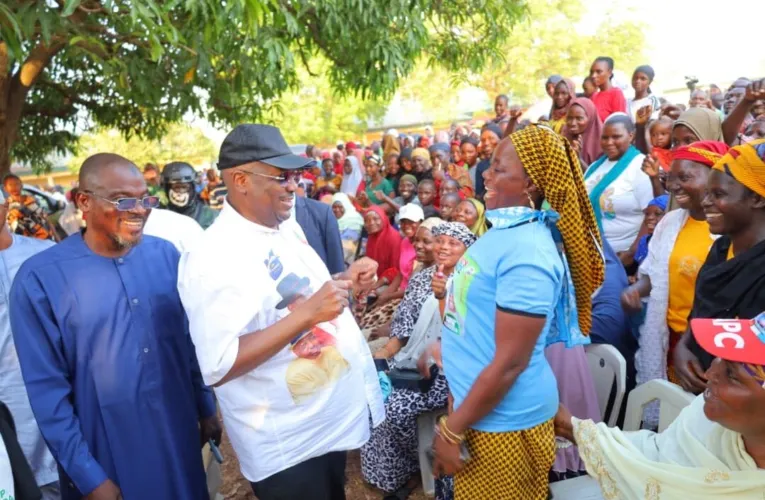
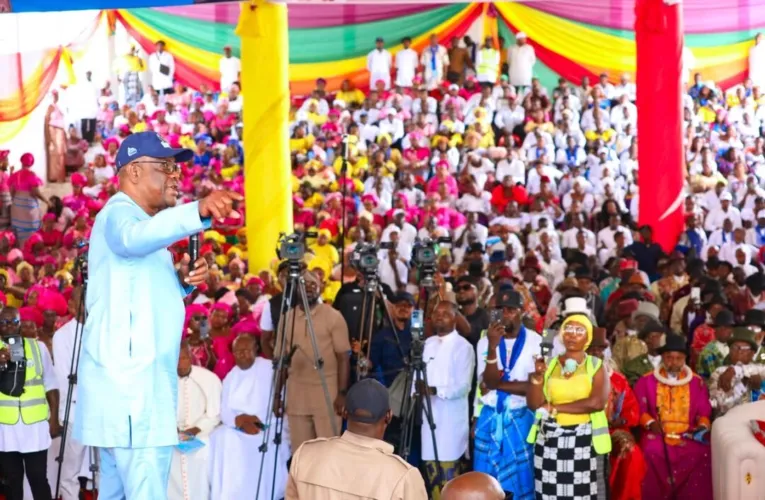
The minister stated this on Friday, during a Rainbow Coalition town hall meeting in Degema Local Government Area of Rivers State, where he urged residents to support continuity in governance rather than return the country to what he described as political uncertainty.
According to him, the economic policies introduced by Tinubu required time to stabilise and deliver their full benefits, warning against disrupting the process by handing power to politicians whose records, he alleged, raised questions about their commitment to national development.
“Don’t go and spoil it by bringing gamblers. Let us continue with this man we have seen now. Let him continue so that we know the economic policies he has laid will stabilise and we will reap from it, and more money will be coming,” Wike said.
He described the removal of fuel subsidy as a difficult but necessary decision, arguing that previous administrations had failed to address the problem despite recognising its negative impact on the country’s economy.
“The President came on May 29, 2023. Immediately he took the oath of office, having identified that this is a problem that has made Nigeria not to move forward, he said he was going to solve that problem.
“As he said, fuel subsidy, bye-bye. Leadership, courage, fairness and firmness. In doing this, he said, yes, I have taken this decision, but there will be challenges. If we persevere, that will be the foundation for the progress of our country,” he stated.
Wike described fuel subsidy as a drain on national resources, arguing that its removal had made more funds available to the three tiers of government.
“Past leaders recognised the fuel subsidy as a sucker, a cancer. But they had no courage to end it once and for all.
“However, President Tinubu came, saw that subsidy must be removed, otherwise the country will die. He saw that already, the country was in a coma and he took that bold and courageous decision, which has brought the country out of coma,” he added.
The former Rivers State governor said the increased allocations to state and local governments were already translating into visible development, noting that local government chairmen now had greater financial capacity to provide infrastructure and other essential services.
He cited the development projects executed by the Degema Local Government Chairman, Michael John Williams, as evidence of what could be achieved when available resources were matched with purposeful leadership.
Wike recalled that during his time as chairman of a local government council, allocations were often exhausted by recurrent expenditure, particularly the payment of primary school teachers’ salaries, leaving little or nothing for capital projects.
“In those days, when money was being allocated to you as a local government, assuming Degema got N700 million, it would be used to pay primary school teachers’ salaries, and what you would see remaining was zero. That means no one naira had come into Degema for development,” he said.
He also attributed the reduction in strikes in public universities to improved funding, saying the prolonged industrial disputes that disrupted academic calendars under previous administrations had become less frequent.
“Why is it that there are no more strikes in universities? Why? Before, when you send your son or daughter to study a four-year course, you assume it will take six years because of constant ASUU strikes. Now, there are no more strikes. Why? Funds are made available. That is what leadership can do,” he said.
Wike, however, acknowledged that the reforms had come with economic difficulties for Nigerians but maintained that the foundation for recovery had been laid.
Turning to the 2027 presidential election, the minister criticised former Vice President Atiku Abubakar over his repeated attempts to become president, questioning the wisdom of entrusting the country’s leadership to someone who, according to him, had contested the presidency across several decades.
He recalled Atiku’s presidential bids in 1993, 2003, 2007, 2011, 2015, 2019 and 2023, noting that the former vice president was again seeking the presidency ahead of the 2027 election under the African Democratic Congress (ADC).
“Two days ago, Atiku was 80 years old. He started running for the presidency when he was 47. In 1993, he ran under the Social Democratic Party. In 2003, he came again. In 2007, the present President gave him a ticket in the Action Congress. In 2011, he came to the PDP. In 2015, he went to the APC. In 2019, he came to the PDP, and in 2023, we both ran. Now, in 2027, he is running again under the ADC,” Wike said.
He questioned the former vice president’s record in government, particularly his role in the privatisation of public enterprises during the administration of former President Olusegun Obasanjo.
Wike also criticised former Rivers State Governor Rotimi Amaechi, accusing him of abandoning major projects and mismanaging public resources during his tenure.
He specifically cited the proposed Karibi-Whyte Specialist Hospital, which he said was conceived as a 1,000-bed specialist facility but remained uncompleted despite an alleged expenditure of $39 million.
According to Wike, the amount was equivalent to about N53 billion at the exchange rate he referenced, while he questioned the fate of the project and the former Airport Hotel.
The FCT minister also faulted the previous administration’s mosquito-control programme, alleging that $10 million was spent on fumigation without achieving the promised results.
He challenged those responsible to explain the expenditure, particularly as residents continued to contend with mosquito bites and malaria.
Wike maintained that political leadership should be assessed based on verifiable achievements rather than campaign promises, insisting that leaders must demonstrate the capacity to translate public resources into tangible development.
Earlier, the Vicar of St Andrew’s Anglican Church, Bakana, Ven. Dr Isobeye Amabibi, commended Wike for what he described as his contributions to the development of Degema and other communities.
Amabibi specifically praised the provision of electricity to Bakana, saying residents were enjoying uninterrupted power supply, while also acknowledging ongoing infrastructure projects, including the landing jetty and road construction.
He appealed for the construction of internal roads to enable residents to access communities beyond the point where the existing road terminates.
The cleric also urged the incoming Rivers State administration to consider extending the road network to Tombia, Bukuma and Buguma to improve connectivity across the Kalabari communities.
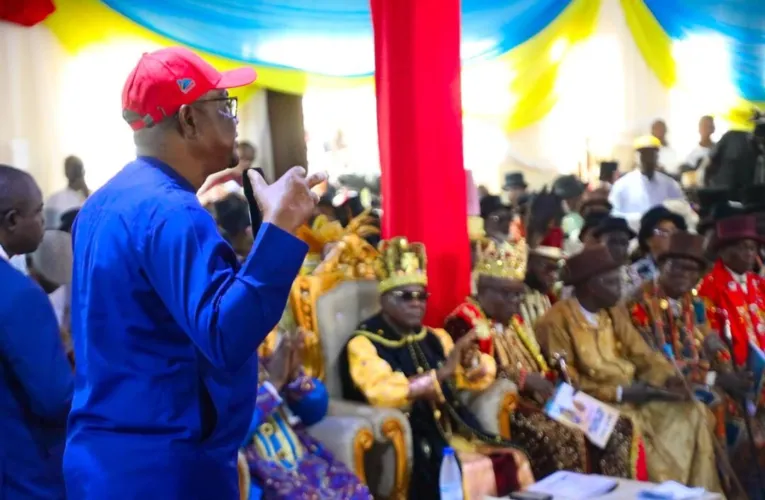
Similarly, the Amanyanabo of Ancient Ke and Chairman of the Degema Local Government Area Council of Traditional Rulers, HRH Rt. Hon. Agolia Aboko Omoni, commended Wike for recognising traditional rulers and upgrading some traditional stools to second-class status during his tenure as governor.
Omoni, who spoke on behalf of traditional rulers in the area, said Wike’s decision to recognise the Amanyanabo of Ke, King Lawrence Odum of Bakana and the Amanyanabo of Bille had helped strengthen traditional institutions and promote peace in the communities.
He also applauded President Tinubu for the ongoing Lagos-Calabar Coastal Highway project, describing it as an important infrastructure initiative that would open up economic opportunities for coastal communities in Rivers State.
According to him, the highway would enhance connectivity across the coastal states and support the development of the blue economy.
The traditional ruler urged Wike to convey the appreciation of the Degema traditional institution to the President, while expressing optimism that the project would extend economic benefits to the area.
He further called on Wike to continue grooming younger political leaders who could sustain his political legacy and provide leadership in Rivers State.
In his remarks, the Amanyanabo of Bakana, HRH King Lawrence O.O. Odum, also commended Wike for his contributions to the development of Rivers State, particularly his efforts to secure oil wells for the state during his tenure as governor.
Odum said the recovery of the Soku oil wells had contributed to improving the state’s revenue base, adding that traditional rulers and residents of Degema appreciated Wike’s political and developmental interventions.
He also pledged the support of the people of Degema for the political direction being pursued by Wike and his allies ahead of the 2027 elections.
The Degema Local Government Chairman, Hon. Michael John Williams, also praised Wike for his support and for providing opportunities for continuity in local government leadership.
Williams said the projects executed by his administration were aimed at improving infrastructure and delivering the dividends of democracy to residents.
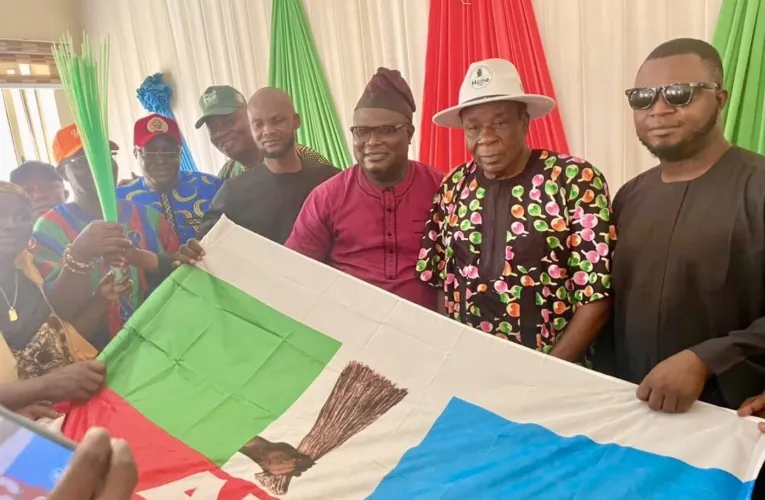
The meeting was attended by political leaders, traditional rulers, community stakeholders and supporters of the Rainbow Coalition.