
















Five Things We Got Wrong About Community Dialogue on GBV And What We Changed
…
We are in the palace courtyard in Shao, and the programme is about to fall apart.
The Ohoro has been listening while we explain the Community Charter of Commitment; the document we want communities to adopt as a public accountability mechanism against gender-based violence. We submitted it weeks before. We followed what we thought was the correct protocol and we were ready to launch.
He was not.
“A document like this must pass through our internal process,” he said. “The community must be part of the team to develop the charter.”
Outside, people are already gathering for the dialogue session. Our facilitation materials are laid out. The team has been preparing for months. And the community’s most senior traditional authority has just told us, politely and firmly, that our centrepiece accountability tool is not welcome; at least not in the form we have brought it.
No one on the team said anything for a moment. We asked for a private meeting.
We did not know it then, but the Shao courtyard was the first of several corrections. We ran GBV prevention dialogues in four communities across Kwara State. In each one, something we had planned for did not survive contact with the community. These are the five things we got wrong, and what we changed.
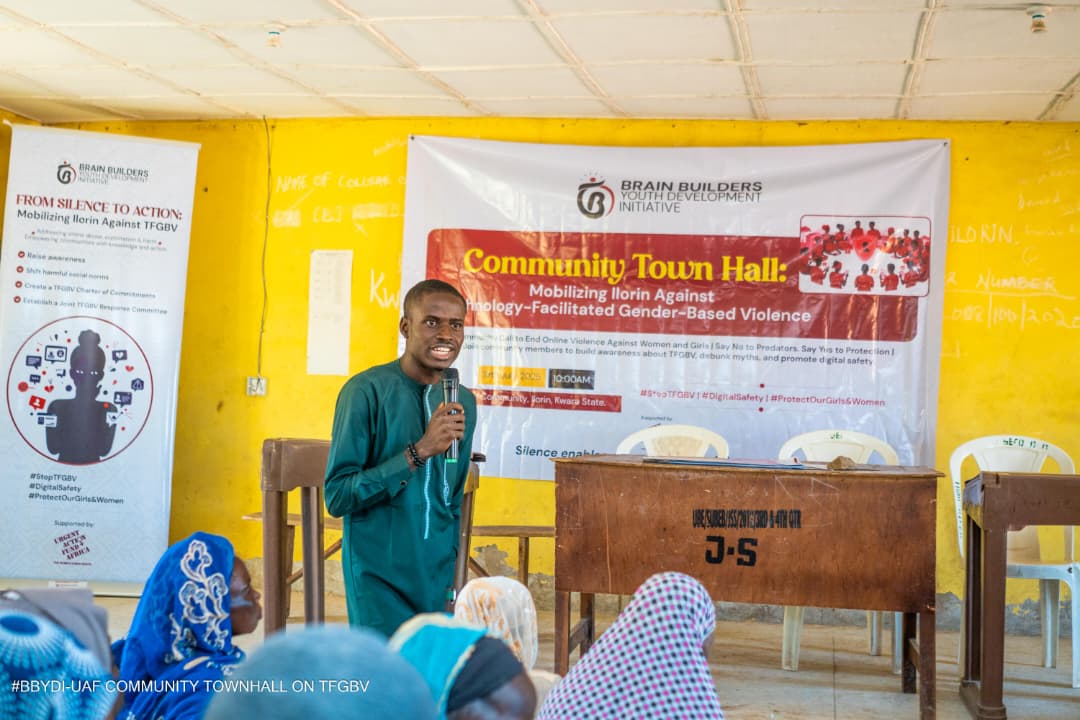
In 2025, Brain Builders Youth Development Initiative ran community dialogue sessions on gender-based violence in Agbarere, Alalubosa, Shao, and Ganmo in Kwara State, bringing together men, women, youth, and traditional and religious leaders.
- Urgency does not equal turnout
Our target was 150 participants per community. GBV is a lived reality in every community we enter, and we assumed that public mobilisation tools like posters, community announcements would be enough to fill the room.
Ganmo showed us otherwise. Seventy-five people came, and our first reaction was that the mobilisation had failed. But Ganmo has roughly 100+ households. What looked like underperformance was, in fact, near-complete community representation. Our target was the problem. A flat number applied identically to communities of very different sizes, as though a village of 70 households and one of 120 should produce the same attendance.
So instead of announcements, we went to people’s homes. On the morning of each session in the remaining communities, the team moved door-to-door with youth leaders, women leaders, and respected elders, personally inviting households. Session times were adjusted around market days, prayer schedules, and farming patterns because dialogue scheduled during harvest means nothing to someone in the field.
Agbarere, roughly 120 households, drew 258 participants. That’s more than two per household on average. Alalubosa: 154 from about 100 households. Shao, despite the leadership tensions described above, turned out 130 from 92 households. The difference went beyond headcount. In the sessions that followed relational mobilisation, people stayed until the end. They argued. They pushed back on each other.
- Informing leaders is not the same as securing legitimacy
Back in the Shao courtyard, during the private meeting, we tried a different framing. Rather than presenting the intervention as something being delivered to the community, we described it as a tool the Ohoro’s leadership could use to address GBV on his own terms.
He agreed to attend the session. For over an hour, he sat and listened without speaking. Then he stood up and publicly endorsed the initiative, urging the community to take the issue of GBV seriously. That was a turn none of us had anticipated.
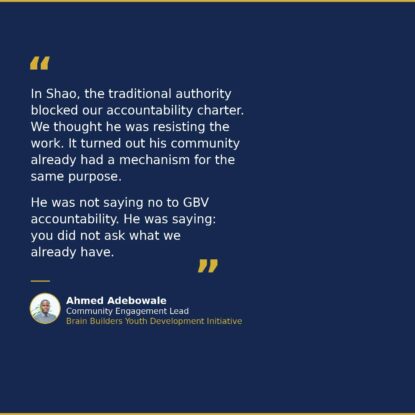
But the Charter was not launched. And when we sat down afterwards to understand the resistance, the lesson turned out to be more than a matter of timing or protocol. Shao already had a Marriage Undertaking that was a locally developed accountability mechanism that served a similar function to the Charter we had brought in. The Ohoro was not opposed to GBV accountability. He was telling us, in the most direct way available to him, that his community already had a structure for this, and ours had not acknowledged it.
Every subsequent community entry looked different after Shao. The team met with community heads before implementation, shared session plans transparently, and asked; before introducing anything, what accountability structures the community already used. Community Charters launched in Ganmo and Agbarere without friction. The difference was in how we approached, not in where we went.
- Safe spaces generate disclosure and you must be ready
Our dialogues were designed as awareness sessions. People would listen, ask questions, and debate prevention strategies. That was the plan.
What happened instead is that participants began disclosing personal experiences of violence; their own, and cases they knew of in the community. The sessions became, unexpectedly, the first structured and moderated spaces many of these communities had ever had for discussing GBV openly. People had things to say and, until that point, nowhere credible to say them.
This caught us flat-footed. We had prepared awareness materials and facilitation guides, not response infrastructure. Mid-project, we had to build it. In Alalubosa, a GBV Desk was established and chaired by the Magaji, giving the community a local entry point for reporting and referral. A formal partnership with the National Human Rights Commission created a pathway for case escalation. Facilitators received additional training in managing trauma-sensitive conversations, and follow-up mechanisms were introduced for cases reported after the sessions.
Within three months, twelve GBV cases were formally reported through the structures that grew out of the dialogues. These communities had no prior reporting mechanism, which does not mean GBV was absent before the intervention. It means the architecture to surface it, document it, and act on it had never existed locally. Ten of those cases were resolved through mediation facilitated by the NHRC. Two remain active.
- Conversation without institutional anchoring dissipates
The dialogues in all four communities were intense, contested, emotional, and sometimes uncomfortable. It would have been easy to assume that the quality of conversation alone would carry the work forward.
In Ganmo and Agbarere, where Community Charters of Commitment were launched, that assumption would have been partly right. Leaders in those communities began referencing the Charter commitments in subsequent discussions, weeks and months after the original sessions. In Alalubosa, the GBV Desk continues to function as a reporting and response point. The formal mechanisms gave the conversations an institutional life beyond the day they happened.
Where no such mechanism was established, the energy from the dialogue faded. Good conversations do not, on their own, become governance.
- Don’t assume who your allies will be
Privately, the team had expected male participants, particularly younger men, to be the most resistant voices in the room. GBV prevention dialogue, in our mental model, was something men would need to be brought along to, managed through, persuaded of.
In Agbarere, during a heated exchange, an older participant argued that “discipline” within marriage was sometimes misunderstood. A young man in his early twenties stood up. “If discipline means violence,” he said, “then we have learned the wrong thing.”
After that session, several of the young men who had spoken up volunteered for future mobilisation. Some were later inaugurated as Community GBV Ambassadors, carrying the work into their own networks. What the dialogue had given them was a space where a younger man could challenge an older one on this subject openly, without it being read as disrespect.
What we still haven’t solved
These five adaptations improved the model considerably. But they also exposed limits we have not yet addressed.
The community structures work. Cases are being surfaced, reported, and referred. The problem is what happens after referral. Our primary pathway, through the National Human Rights Commission, addresses legal resolution, and it has been effective for the cases that fit that pathway. But legal mediation does not cover psychosocial support, and it does not reach the attitudinal shifts that prevent reoccurrence. If this model goes to twenty new communities, the volume of cases the dialogues surface will outpace the response system’s capacity. That gap is the most pressing thing on the team’s mind right now.
There is also a design question that Shao left us with, and that we still have not settled. The Community Charter worked well in Ganmo and Agbarere. In Shao, the community’s own Marriage Undertaking already served a similar accountability function. Whether to standardise our tools or learn to work with what communities have already built, even when it looks different from what we designed, is a question that will probably need a different answer in every community we enter next.
These five lessons did not simplify anything. But they replaced a set of assumptions with a willingness to be corrected by the communities we are trying to serve.
About the author
Ahmed Adebowale is a Community Engagement Lead at Brain Builders Youth Development Initiative, where he designs and facilitates community dialogue programmes on GBV prevention across Kwara State. He was present at every session described in this article.