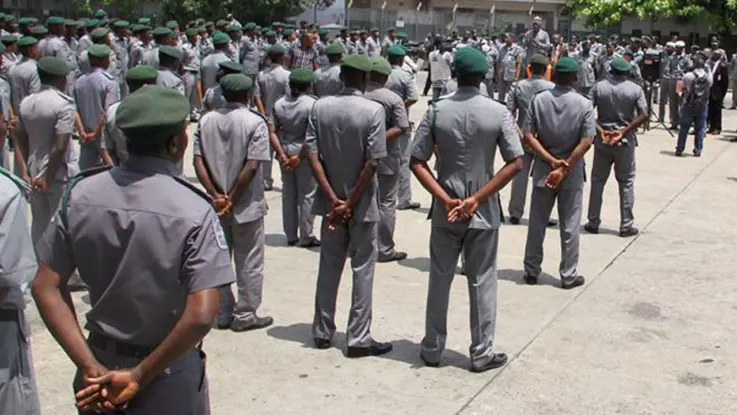
The Nigeria Customs Service has suspended training activities for 3,852 newly recruited officers, nearly two years after it began the recruitment process, following concerns raised by the Federal Character Commission over alleged irregularities in the selection and invitation of successful candidates.
The suspension was announced on Friday in a statement signed by the Deputy Comptroller of Customs and National Public Relations Officer, Abdullahi Maiwada. It came after engagements between the management of the Customs Service and a delegation of the Commission, with both institutions agreeing to further consultations to resolve the disagreement.
The statement read, “The Nigeria Customs Service has temporarily put on hold the ongoing training activities at its two training colleges to allow further consultations and dialogue with the Federal Character Commission towards the amicable resolution of concerns raised in connection with the ongoing recruitment exercise.
“The decision follows engagements between the Commission and a delegation of the NCS, during which both parties reaffirmed their commitment to resolving the issues through constructive dialogue, mutual understanding and continued institutional collaboration.”
Maiwada said the suspension is aimed at allowing the two agencies to resolve the disagreements surrounding the recruitment process through further consultations and dialogue.
The development comes amid questions over the selection of successful candidates, following complaints by applicants who alleged that they were excluded from the training exercise despite appearing on the published final recruitment lists.
The Service said both institutions had reaffirmed their commitment to resolving the issues through constructive dialogue, mutual understanding and continued institutional collaboration.
It stated that the Comptroller-General of Customs, Bashir Adewale Adeniyi, had reiterated the agency’s commitment to working with relevant government institutions in the national interest.
The statement read, “In consideration of the concerns raised by the Commission and in line with the series of engagements, the Comptroller-General of Customs, CGC Bashir Adewale Adeniyi, MFR, has reaffirmed the Service’s commitment to institutional collaboration and constructive engagement with relevant government institutions in the overall national interest.
“Furthermore, the CGC acknowledged the critical role of FCC in promoting national unity, fairness and equitable representation in public service appointments, noting the importance of its constitutional mandate in strengthening inclusiveness and ensuring that the principles of federal character are upheld across the Federation.”
The Customs Service added that it valued its longstanding relationship with the Commission and was confident that the ongoing discussions would provide an opportunity to address the concerns raised.
“The NCS values its longstanding relationship with the FCC and remains confident that the ongoing dialogue will provide an opportunity to address the concerns raised in a mutually beneficial manner, while reinforcing the shared commitment of both institutions to fairness, national cohesion and effective public service delivery,” it stated.
The Service also pledged to maintain transparency and accountability throughout the process, stressing that it would continue to engage relevant government institutions to strengthen public confidence in its operations.
The dispute comes against the backdrop of a recruitment exercise that began with a newspaper advertisement on December 27, 2024, when the Customs Service announced 3,927 vacancies across its Superintendent, Inspectorate and Customs Assistant cadres.
The exercise attracted more than 573,000 applications, with 286,697 candidates initially shortlisted for the next stage after the first round of documentary screening.
Following subsequent assessments, the Service published its final lists between July 28 and 30, 2026, announcing 3,852 successful candidates comprising 1,275 officers in the Superintendent Cadre, 367 in the Inspectorate Cadre and 2,210 in the Customs Assistant Cadre.
The training exercise subsequently commenced on October 9, 2026, with successful candidates reporting to the designated training colleges.
However, the recruitment process became contentious after some applicants complained that they had been excluded from training despite completing the required screening and documentation exercises and seeing their names on the published lists.
The Federal Character Commission subsequently raised concerns about the process, including allegations that some candidates whose names appeared on the final lists were not invited for training, while some individuals whose names were not published allegedly received invitations.
The Commission also cited complaints from more than 500 applicants who claimed they had completed the necessary stages, including medical examinations, but were subsequently excluded.
In its position on the controversy, the FCC argued that the complaints required investigation to establish whether the recruitment process complied with the applicable federal character principles.
The Commission called for the suspension of the training exercise pending an examination of the disputed recruitment process. It also said its 330th plenary session had resolved to suspend Customs recruitment activities indefinitely.
The latest decision by the Customs Service to put training activities on hold comes as both institutions seek an amicable resolution of the disagreement.
The controversy has placed renewed attention on the constitutional responsibility of federal institutions to ensure fairness and equitable representation in public appointments, particularly in recruitment exercises involving thousands of applicants from across the country.
The federal character principle is intended to prevent the concentration of public appointments and opportunities in a few states or sections of the country, while promoting national unity and balanced representation.
The Service, however, expressed confidence that continued engagement would produce a resolution that would protect the interests of both institutions and reinforce public confidence in the recruitment exercise.