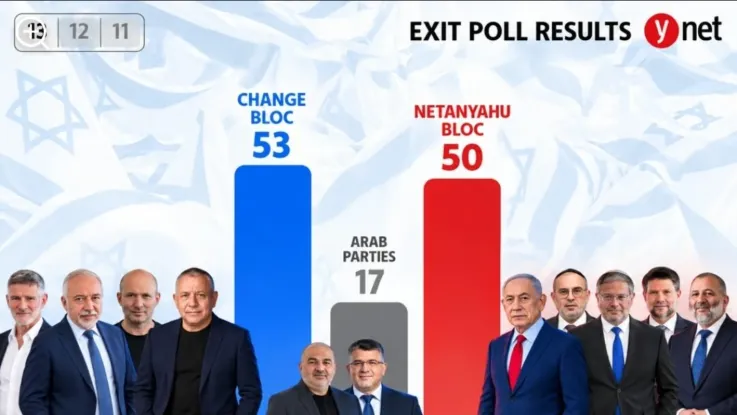
Prime Minister Benjamin Netanyahu appeared to lose significant support to opposition leader Gadi Eisenkot in Tuesday’s Israeli election, according to exit polls, but neither bloc won enough seats to secure a clear majority.
Netanyahu’s Likud party was projected to win 25 seats, with his right-wing alliance on 50, according to the Kan 11 exit poll published after voting ended. That would be a massive drop from the 32 they currently hold.
Despite the drop, Likud is still projected to be the single largest party.
The “Change” opposition bloc is slated to win 52 to 53 seats. Opposition parties currently hold 50 seats in the 120-member Knesset.
“If these are the final results, they would mark a victory,” Eisenkot said in a statement.
“Netanyahu’s bloc suffered a tough defeat,” added Yair Lapid, a fellow opposition leader. “This is a total collapse and the public told them to go home.”
At least 38 parties contested the Knesset, leaving minor players — especially Israel’s Arab parties — in a position to decide the future of the country as both blocs jockey for a majority.
The big story was the huge gain for Israeli Arabs, who make up about 25% of the population. They were on pace to score 17 seats, a sharp increase from the 10 seats they held prior to the election. Tuesday’s election saw high Arab voter turnout compared to 2022.
That could leave them as kingmakers — if Eisenkot breaks a campaign promise and works with them.
“When you have Arabs at 17, you can’t disregard them,” Israeli journalist Attila Somfalvi said at the Israel Press Club’s election-night press centre in Tel Aviv.
Retired Israeli Air Force Maj. Gen. Nimrod Sheffer, a candidate for the left-wing Democrats party that scored 9-10 seats in exit polls, revealed Tuesday that the anti-Netanyahu coalition had met with Arab leaders to discuss forming a new government together.
It will take time to count ballots as Israel officiates its elections manually.
Official results will be clearer Wednesday, but it could take three weeks to a month for winning parties to establish a coalition.
It will fall on Israeli President Isaac Herzog to select a party leader he believes can win majority support in the Knesset.
Herzog has three chances to tap a candidate, but should the Knesset fail to rally around his pick, a new round of elections would be held.
Netanyahu will remain acting prime minister until a new premier is elected.
‘I’ll Act Immediately To Replace Netanyahu’: Eisenkot
Gadi Eisenkot, leader of the Yashar! party, vowed Tuesday night to act immediately to replace Netanyahu’s government after exit polls gave the bloc seeking political change a narrow advantage, although neither side secured the 61 seats required for a majority in the 120-member Knesset.
“The initial results indicate a complete vote of no confidence in Netanyahu and the government of October 7 by the Zionist majority and the majority of Israeli citizens,” Eisenkot said, referring to the government in office during the Hamas-led attack on Israel.
“If these are the final results, this is a victory for the mainstream Zionist majority in Israel,” he added. “I will act immediately to implement the people’s decision, replace Netanyahu’s government and establish a Zionist government committed to military conscription as soon as possible.”
The average of exit polls by Kan 11, Channels 12 and 13 gives the change bloc 53 seats, compared with 50 for Netanyahu’s bloc. Arab parties are projected to win a combined 17 seats.
Eisenkot’s Yashar! Projected To Win 19 To 23 Seats
Eisenkot’s Yashar! party is projected to win 21 seats in Kan 11’s exit poll, 22 in Channel 12’s and 23 in Channel 13’s. The i24NEWS poll gives the party 20 seats, while Channel 14 projects 19.
Across all five exit polls, the former military chief’s party averages 21 seats, placing it among the country’s largest factions, behind Likud.
Eisenkot, Israel’s 21st IDF chief of staff, entered politics in 2022, three years after leaving military service. He joined Benny Gantz’s National Unity alliance and was placed third on its electoral list.