



Burkina Faso Opens First Gold Refinery To Process Mineral Wealth At Home
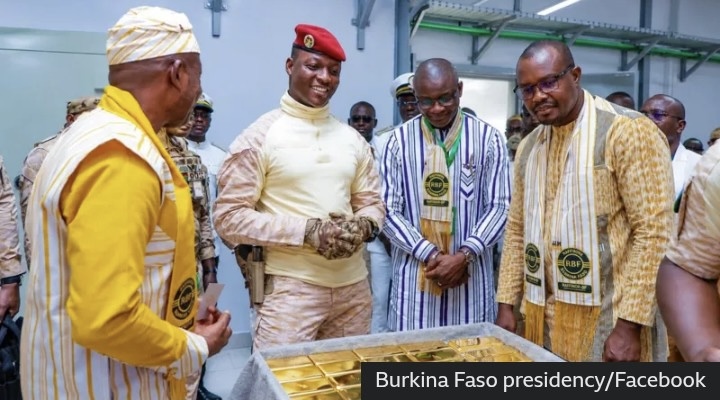
Burkina Faso has opened its first gold refinery as the military-led government seeks to process more of the country’s mineral wealth at home and tighten control over one of its most important industries.
Junta leader Ibrahim Traoré said the move was part of a wider effort to end reliance on exporting raw materials for processing abroad.
“We want to refine all our metals on site… we want to have the entire value chain on site,” he said at the plant’s inauguration in Ouagadougou on Monday.
Burkina Faso is one of Africa’s biggest gold producers, but authorities have struggled to regulate the informal mining sector, which has been blighted by jihadist violence.
Traoré’s government hopes the new facility can turn the landlocked country into a regional gold-refining hub.
Foreign mining firms are now required to give the state a 15 per cent stake in their operations and train local workers.
The World Gold Council said output rose by 17 per cent year-on-year in the second quarter of 2026, helped by increased production at several mines.
But successive governments have struggled to regulate the extensive artisanal and small-scale mining industry, where smuggling and informal trading have made it difficult to account for all the gold produced.
The government has also alleged that some illegally traded gold helps finance the Islamist insurgency that has engulfed much of the country.
Burkina Faso has been fighting armed Islamist groups linked to al-Qaeda and Islamic State for years, with large areas outside full government control.
The new refinery, known as Raffinor-BF, cost more than 11bn CFA francs ($19m; £14m), according to the presidency.
It said the project was financed by the state, including through the National Precious Metals Company (Sonasp), in partnership with the private sector.
The plant will initially be capable of refining 164 tonnes of gold a year, significantly more than the country’s current annual production. The government says its eventual capacity could rise to 515 tonnes, suggesting it also wants the refinery to process gold from elsewhere in the region.
“This is the day we take back the keys to our own house,” Mines Minister Yacouba Zabré Gouba said at the opening. “Our gold will no longer be used to create added value for others while our people remain in need.”
The refinery is the latest element of Capt Traoré’s drive to increase state control over natural resources and reduce economic dependence on foreign companies and former Western partners.
Since taking power in a coup in September 2022, the 38-year-old army captain has promoted a nationalist economic agenda centred on domestic production and greater control of strategic industries.
His government has increased state involvement in the mining sector and sought to reorganise the trade in artisanal gold. The authorities suspended exports of gold produced by artisanal and semi-mechanised mines in 2024, saying the move was intended to better regulate the sector.
Traoré has previously accused smugglers of taking large quantities of gold out of Burkina Faso illegally and said some of the proceeds were helping finance militant groups.
The refinery also forms part of a broader campaign to process more commodities domestically rather than exporting them in raw form.
Traoré has presented such projects as evidence of Burkina Faso becoming more economically self-reliant, alongside investments in industries including cotton, textiles and food processing.
His policies have coincided with historically high international gold prices and increased global production. Worldwide mine output reached an estimated record 3,672 tonnes in 2025, according to the World Gold Council.
Burkina Faso’s government says the new plant should eventually be capable of refining all the gold produced by both industrial mines and artisanal miners.
Several West African countries are also seeking to process more gold at home. Guinea and Ghana have restricted exports of unrefined gold, while Mali is building its first refinery with the help of a Russian firm. Ivory Coast also plans to open a refinery next year.