



















Saudi Oil Exports at Risk as Drone-Damaged Pipeline Remains Shut
Saudi Arabia will run out of oil stocks for export if it does not restart a drone-damaged major pipeline to the Red Sea within days, leading to the loss of up to 4 per cent of global supply, Saudi oil buyers and traders have said.
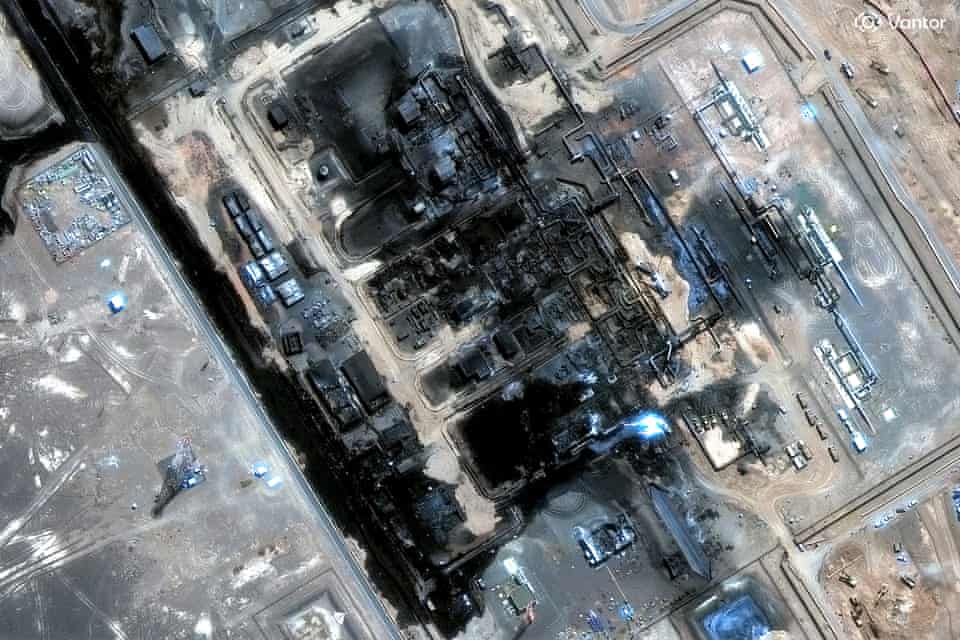
Satellite photos released on Sunday night appeared to show a pumping station on the key 1,200km (745-mile) Saudi East-West pipeline charred and badly damaged after drone attacks on Friday.
A further decline in oil flow from Saudi Arabia, the world’s largest oil exporter, will worsen the global supply crunch, which has already pushed fuel prices to record highs and spurred inflation around the world.
The news comes as Yemen’s Iran-aligned Houthi forces have launched attacks on targets in Saudi Arabia and captured the strategic island of Perim in the Bab al-Mandab Strait, expanding their control of the narrow waterway.
On Sunday, the international oil benchmark, Brent crude, rose by more than 3.4 per cent to $108 per barrel, a level not seen since May.
Since the drone attacks forced the shutdown of the pipeline, Riyadh has yet to provide full details on the extent of the damage or how long the route will remain offline. The Saudis blamed the attack on drones launched by militants in Iraq.
Sources who spoke to Reuters gave varying estimates, with one saying the damage could take up to six weeks to repair, while another said it could be fixed sooner and could resume pumping partially while repairs are ongoing.
Saudi Arabia’s government media office and energy ministry did not immediately respond to requests for comment. Two officials who spoke on condition of anonymity to the Associated Press said the pipeline would be mostly out of service for weeks.
For the past six months, the pipeline running through the desert across the Arabian Peninsula has spared Saudi Arabia from the brunt of the impact of the wartime shutdown of the Strait of Hormuz that has crippled exports from its neighbours.
The world’s biggest exporter has used the pipeline to reroute around 4 million barrels per day – about 4 per cent of global supply – to the port of Yanbu on the Red Sea.
But with the pipeline out of service, Yanbu now has stocks to maintain exports for just five to seven days, according to three industry sources familiar with Saudi exports.
Saudi Arabia also has stocks to supply customers for several days from Egypt’s ports of Ain Sokhna on the Red Sea and Sidi Kerir on the Mediterranean, a fourth source said.
Stocks are not full and will ultimately run out without the East-West pipeline resuming operations, the four sources said.
As the price of oil climbed, hopes for a diplomatic breakthrough in the near term faded when Oman’s Foreign Minister, Sayyid Badr Albusaidi, posted late Sunday that a regional meeting scheduled for Monday had been postponed “in the interests of consensus.”
Iranian officials had said they would attend that gathering with Gulf Arab states to present an agreement with Oman on governing shipping routes through the Strait of Hormuz.
The strait was free to transit before the war, but Iran now requires vessels to obtain permission and is considering a mechanism to impose service fees.
The disruptions to crude have driven up prices across refined derivatives such as petrol and diesel. Diesel prices in the US hit a record on Friday, soaring past $6 a gallon on average.
The Houthis are targeting Saudi oil infrastructure and shipping as part of a recently declared blockade. Recent advances by the Iran-aligned group put them closer to a major US base in Djibouti.
The spiralling conflict in the Middle East is now in its seventh month, after the US and Israel launched attacks on Iran on February 28 and Donald Trump declared the war would be finished in four to six weeks.