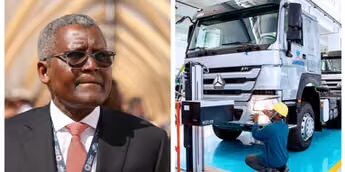
Africa’s wealthiest man, Aliko Dangote, is expanding his ambitions in the commercial vehicle market, moving from importing thousands of compressed natural gas (CNG)-powered trucks to introducing electric vehicles through his partnership with China’s automotive giant, Sinotruk.
The new electric vehicle was unveiled on November 15, 2026, at the Dangote Sinotruk West Africa Limited assembly facility in Ikeja, Lagos, marking the company’s entry into electric commercial vehicle assembly.
The development adds electric trucks to its existing portfolio of heavy-duty trucks, tippers, pickups, light trucks and buses.
The latest move extends Dangote’s involvement in alternative-fuel transportation beyond CNG, as his businesses explore technologies that could reduce dependence on conventional diesel-powered transport.
However, the CNG truck acquisition was undertaken by Dangote Petroleum Refinery for fuel distribution, while the electric truck is being introduced through the Dangote-Sinotruk joint venture.
In August 2025, Dangote Refinery began receiving 4,000 CNG-powered trucks from China as part of a ₦720 billion investment in its nationwide petroleum distribution programme.
The first batch began loading petroleum products for distribution in September 2025, with the initiative designed to reduce reliance on third-party fuel transporters.
Speaking at the electric truck unveiling, Devakumar V.G. Edwin, Group Vice-President of Dangote Industries Limited, said the company was responding to changing technology in the global commercial vehicle industry.
“Today, we are taking an important further step as the global economy is looking for sustainable business, that is, vehicles which will also be protective of the environment. So, we went into CNG technology and now we are going into the electric technology. This is a technology which is revolutionising the whole world,” Edwin said.
According to TheCable, Edwin said electric commercial vehicles could lower operating costs and reduce tailpipe emissions, although the benefits would depend on electricity prices, charging infrastructure and the nature of their applications.
“The electric commercial vehicle offers the potential for lowering the operating cost and reducing the tailpipe emissions. Depending on the application, the electricity cost and the charging infrastructure, it is going to be highly beneficial to the people,” he added.
Sinotruk Group President Liu Wei said the partnership had assembled more than 8,000 vehicles locally since its first heavy-duty truck rolled off the Nigerian assembly line in 2017. He described the electric truck as the first new-energy truck assembled on the African continent.
The company says it is preparing charging infrastructure, spare parts and after-sales support, alongside technical training for Nigerian engineers and technicians.
However, it has not disclosed the electric truck’s price, battery capacity, driving range or planned production volumes, leaving questions about its commercial rollout and potential adoption by transport operators.