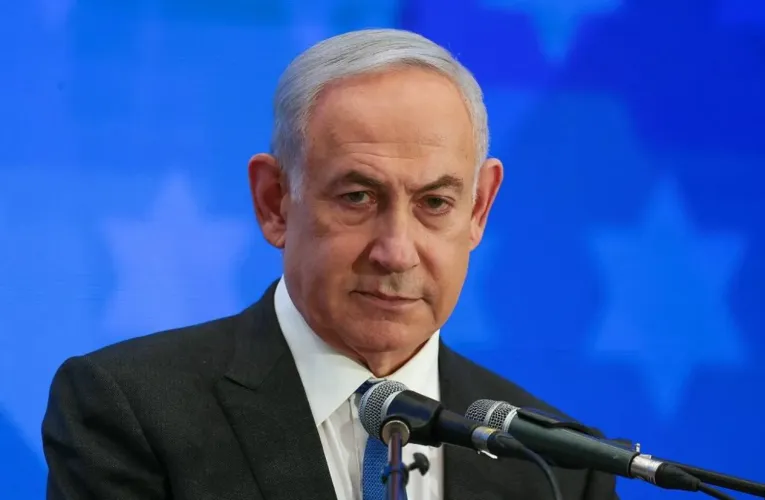
Benjamin Netanyahu looked set to remain Israel’s caretaker prime minister after unexpectedly strong backing among Jewish voters left his opponents little prospect of unseating him, despite his right-wing bloc losing its parliamentary majority.
With nearly 86% of votes tallied on Wednesday, Israel’s three main broadcasters projected Netanyahu’s bloc of right-wing, far-right and ultra-Orthodox parties would win 53 seats in the 120-seat Knesset, ahead of 48 for rival Gadi Eisenkot’s opposition bloc.
Parties representing Arab Israelis were projected to win an unprecedented 19 seats, leaving Eisenkot little realistic path to power without their broad backing, which many Jewish political leaders reject.
Results could still change as counting continued, but Eisenkot’s bloc of anti-Netanyahu parties, ranging from centre-left to hard right, fell short of pre-election polls that forecast a tight race.
Netanyahu would remain caretaker prime minister during any coalition negotiations and potentially until another election next year.
While a caretaker government faces constraints, experts say it retains powers, including over the war with Iran.
Guy Lurie, research fellow at the Israel Democracy Institute, said a caretaker government formally has the same powers as a regular government, but has “a duty of restraint” and less discretion in some areas.
Netanyahu, addressing his Likud party faithful after 3 a.m., called for a “strong, right-wing national government.”
He highlighted Israel’s military successes and raised the prospect of renewed joint military action against Iran alongside US President Donald Trump, saying both countries had a “singular historical opportunity” to remove what he called the Iranian threat “once and for all.”
Trump, who had urged Israeli voters to keep Netanyahu in power so the two leaders could “finish the job” in Iran, said Netanyahu had done “very well” and claimed his endorsement had “helped him a lot.”
Israel’s high-turnout vote was brushed aside by some in the rest of the Middle East.
In Tehran, banners with images of slain Supreme Leader Ayatollah Ali Khamenei reminded Iranians of US and Israeli strikes launched in February.
“I genuinely see the possibility of attack,” said 50-year-old Iranian citizen Abdollah Karimi.
Frustration was also palpable in Egypt, the first Arab country to make peace with Israel in 1979.
Outhman Selim, a 62-year-old lawyer, said his hopes that a Netanyahu defeat would steer the country away from the far right had been dashed.
Eisenkot acknowledged that Netanyahu remained caretaker PM but warned he might use security for political ends.
“I call on the heads of the security establishment and the civil service: Netanyahu is a caretaker prime minister, without a mandate or the people’s trust. Stand firm in the face of any attempt to challenge you,” he said.
Netanyahu’s office has previously rejected accusations that he is using the Iran conflict for political gain and did not immediately respond to a request for comment on Wednesday.
The prospect of a caretaker government without a parliamentary majority weighed on Israeli markets. The shekel weakened around 1.6% to 3.10 to the US dollar.