









Nigeria’s sons in Russia’s war: 25 dead or missing, and a pipeline no one is stopping
No treaty carries Nigeria’s signature. No battalion has crossed anywhere near Donbas or Kharkiv. And yet, Nigerian names keep appearing on the casualty lists of a war fought on foreign soil.
The number that should stop us is 25.
That is how many Nigerians are now confirmed dead or missing among 215 known Nigerian recruits absorbed into Russia’s armed forces, according to a tally published on June 29, 2026, by http://StopRussianRecruiters.org, the Ukrainian Ministry of Foreign Affairs’ clearinghouse for foreign nationals killed in the war.
Nigeria ranks fifth among African nations on that list, part of 485 confirmed African deaths compiled from a conflict most Nigerians still discuss like distant weather: present tense, but far away, someone else’s forecast.
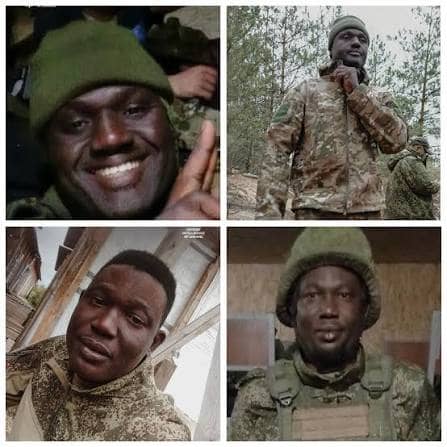
Ayebusiwa Olabode Victor was 34. A former Nigerian Navy veteran, he signed a contract with the Russian military in February 2026, one week after Nigeria’s Ministry of Foreign Affairs had publicly warned against the recruitment of Nigerians into foreign armed conflict. He was confirmed dead by Ukraine’s Defense Intelligence in May. The warning came first. The grave came last.
He is not alone.
Matthew Sunday Bankole, 37, has been held in a Ukrainian prisoner-of-war camp since November 2025.
Kehinde Oluwagbemileke Adisa, 30, came to Russia in 2025 to study population and development, a field concerned, with cruel irony, with how people live and die in aggregate. He later signed a military contract and has been detained since June.
Adisa Ridwan Balogun, 33, has been held since December.
These are not career soldiers. They are Nigerians who were sold one life and delivered into another. They are now case studies in a script that has played out with numbing consistency across the continent.
*How the pipeline works*
The script is simple, and that is why it works. It rarely starts with a stranger. It starts with a cousin’s contact, a childhood friend abroad, an “agent” already known to someone in the family. Someone who has, in the language of the scheme, “made it.”
The pitch moves through channels young Nigerians already trust: WhatsApp groups for job seekers, Facebook pages promising visas, salaries, and eventually Russian citizenship. Informal brokers trade in desperation because the legitimate economy cannot absorb the supply.
The job offered is always civilian: driving, security, logistics, technical work. Exactly the kind of work a job-scarce graduate has been trained to hope for and denied at home.
On arrival in Russia, the recruit is handed a contract in a language they cannot read. It is not with a logistics firm, but with the Ministry of Defense. Passports disappear into drawers. Promised wages are delayed, then withheld, until leaving becomes financially and legally impossible.
What began as an escape from unemployment ends as conscription into a battlefield. For some, it ends on a factory floor assembling the machines that make that battlefield deadlier.
CNN has interviewed African fighters, including Nigerians, who describe the same bait and switch. A joint investigative report counted at least 36 Nigerians recruited to fight for Russia, with five confirmed killed. Ukraine’s military intelligence has logged additional Nigerian cases, recruited via social media and deployed into combat roles for which they had neither training nor consent.
Former Senator Shehu Sani said in July what many were reluctant to say: Nigerians enlisting in Russia’s armed forces are being turned into mercenaries. It is a hard word, and it is accurate. The alternative — that unemployed graduates are simply signing away their lives through bad luck and bad information — indicts the systems that produced them just as much.
Russia’s ambassador to Nigeria has denied any state-backed programme targeting Nigerians, saying illegal recruitment would be a matter for law enforcement. Independent reporting and intelligence sources continue to identify Nigerian victims recruited and deployed to the front, a contradiction the denial has not resolved.
Beyond the battlefield is a quieter economy of exploitation. Researchers and human-rights groups describe these practices as functionally indistinguishable from trafficking. They target economically desperate youth with offers recruiters know to be misleading. Recruits are moved across borders under false pretences, then coerced or financially trapped into military service they never agreed to.
In this reading, affected Nigerians are treated as expendable manpower in a war they did not choose and, in many cases, did not understand they had joined until it was too late.
Every strand of this story leads back to two failures.
The first is economic: a labour market that produces graduates faster than jobs will always create a supply of young people willing to believe an unlikely offer, because the alternative at home is indefinite waiting.
The second is bureaucratic: the gap between the warnings the Ministry of Foreign Affairs has issued and the enforcement that has not followed.
What oversight exists for the online recruiters, the WhatsApp brokers, the Facebook pages converting desperation into a pipeline?
When a Nigerian mission abroad learns a citizen has been deployed to a war zone instead of a warehouse job, what happens next? How quickly does consular help reach families waiting for a call from Ukraine or for clarity from Abuja?
These are questions Nigerian institutions have been slow to answer beyond statements.
What concrete steps has government taken since the ministry raised the alarm?
How many Nigerians recruited, injured, killed, or missing are on official record, and who is keeping it?
What legal penalties exist for Nigerian agents who broker these deals from within the country, profiting while their countrymen are shipped to a front line sold to them as warehouse work?
They are not rhetorical. They are the difference between managing a crisis and narrating it.
History has seen this before. Empires filled their navies not through open conscription but through press gangs and false promises — luring young men with talk of wages and adventure, only for them to wake up at sea, bound to service they never chose and rarely survived. It took public outrage, legal reform, and political will, not condolences, to end it.
Nigeria is at the same fork.
The Ministry of Foreign Affairs must move from warning to prosecution, naming and shutting down brokers and pages operating in plain sight.
The National Assembly must close legal gaps that let the trade continue unpunished.
Nigerian missions abroad must be resourced to find every citizen still trapped in this pipeline, whether on a battlefield or a factory floor, and bring them home.
None of this is optional. None of it should wait for the next name on the list.
Nigeria owes its citizens more than condolences. It owes them a government that acts before the funeral, not after it.