










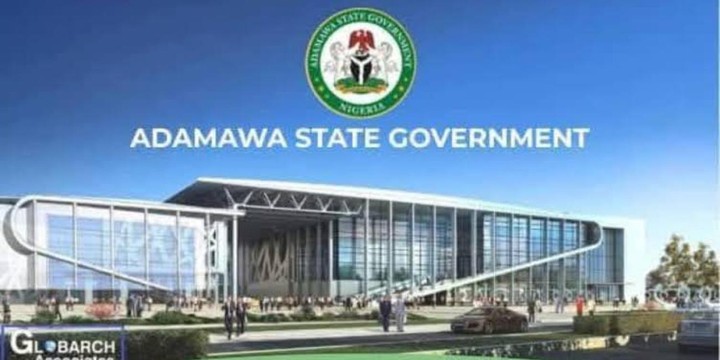
Fintiri Builds ₦19 Billion Confrence Centre, While Children Learn Under Trees
Adamawa Governor Fintiri Faces serious Backlash Over N19Billion Yola Conference Centre While Children Learn In Crumbling Classrooms, Under Trees
Many Adamawa residents say the multi-billion-naira venture represents yet another showpiece of wasteful spending in a state where basic education remains in ruins.
Governor Ahmadu Umaru Fintiri of Adamawa State is facing criticism for continuing to channel billions of naira into the construction of an N18.97 billion International Conference and Events Centre in Yola, even as numerous schoolchildren across the state continue to learn under trees and in crumbling classrooms.
The controversial project, awarded to Lubell Nigeria Limited, is already under active construction.
Commissioner of Housing and Urban Development, Abdullahi Prambe, described the facility as an ultra-modern complex featuring a 1,000-seat main hall, a 360-seat auditorium, seminar rooms, catering and retail areas, medical and support facilities, CCTV security systems, and landscaped surroundings.
But many Adamawa residents say the multi-billion-naira venture represents yet another showpiece of wasteful spending in a state where basic education remains in ruins.
Across several communities, pupils are seen sitting on bare floors or under tree shades due to a chronic lack of classrooms and furniture. Teachers, some with over two decades of service, are still awaiting promotion arrears.
Like many other schools where pupils still learn under trees across the state, Kubaje Dadon Primary School in Mayo-Belwa LGA stands as a stark example of neglect.
“This is reckless governance,” said one education rights activist in Yola.
“You can’t justify spending N19 billion on a luxury event centre when our children don’t even have chairs or roofs over their heads.”
Critics have also questioned the logic of investing such a colossal sum in a hospitality and tourism project[b] at a time when Adamawa remains listed by the United Kingdom and several Western governments as a high-risk travel destination due to insecurity and insurgent activities.[/b]
They argue that in a region still battling banditry and extremist threats, there is no realistic prospect of attracting foreign investors, conference tourism, or international events, making the project’s justification hollow and unsustainable.
“Who is this conference centre meant for?” a Yola-based policy analyst, Benjamin Tenang, asked.
“Foreign investors are not coming to Adamawa, even locals barely travel at night due to insecurity. This project is simply a white elephant dressed in marble.”
Analysts and insiders familiar with state procurement patterns say such grandiose undertakings often serve as conduits for inflated contracts and political kickbacks disguised as “foreign investment drives.”
In most cases, the so-called international investors or consultants linked to these ventures are merely fronts used to legitimise large-scale diversions of public funds.
“They are designed to look good on paper, attract media attention, and create a pipeline for kickbacks under the guise of development partnerships. That’s why governors prefer concrete projects to real human investment. You can’t collect a percentage from a teacher’s salary, but you can from a billion-naira construction contract.”
Observers also accuse the Fintiri administration of using grand construction projects as political trophies while leaving core social sectors like education, healthcare, and rural development in deplorable condition.
“This government has chosen concrete over classrooms,” another civil society source lamented. “Adamawa doesn’t need an event centre right now; it needs functioning schools, qualified teachers, and a serious plan to lift the next generation.”
International observers note that Adamawa is currently rated a “Level 4 — Do Not Travel” zone by the United Kingdom’s Foreign, Commonwealth & Development Office (FCDO), alongside other high-risk areas in Northern Nigeria.
The region also ranks among the least attractive destinations for foreign direct investment according to Nigeria’s 2024 security index.
Analysts say this further weakens any economic justification for the N19 billion project, describing it as “a grand illusion built on insecurity.”